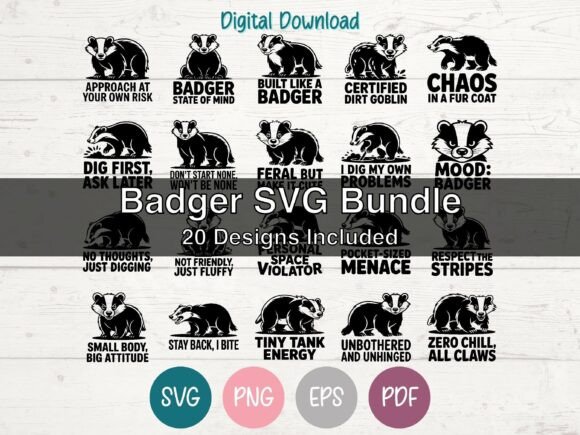
Funny Badger Shirt SVG Bundle of 20: Graphic T-Shirt Designs
Opening a folder of 20 badger illustrations from KayBee SVGs, the first thing that strikes me is a remarkable consistency of hand—a rare quality in many design bundles. The line weight sits in that sweet spot between playful and polished, with a slight inky character that feels intentional rather than accidental. Each badger carries a distinct personality: one squints with suspicion, another grins as if holding a secret, a few strike more majestic woodland poses. This isn't a paste-and-stretch collection; the silhouettes vary enough to support a full product line while remaining unmistakably badger. For a designer assessing whether this asset can carry real client work, that internal variety within a cohesive style is gold. The immediate mood lands somewhere between storybook charm and modern outdoor whimsy—think national park gift shop meets Etsy craft fair, but tidier. It immediately suggests a client who wants approachable nature-themed merchandise, not a zoological encyclopedia illustration.
A Character-Driven Asset for Meaningful Brand Play
When I review any illustrated asset, I mentally place it into a mock brief. With this badger bundle, the client project that springs to mind is a small-batch apparel line for a regional conservation group hosting an annual “Badger Day” fundraiser. They need t-shirt graphics, tote bag prints, stickers, and social media assets that feel authentic, warm, and vaguely humorous without becoming cutesy. The various expressions across the 20 designs let me assign different “roles”: the stoic badger becomes the hero logo on the back of a hoodie, the grinning one works perfectly on a kids’ tee, and the curious side-profile badger anchors an Instagram post promoting trail clean-up. This kind of micro-narrative flexibility is exactly what makes a character-driven graphic design asset useful beyond a single application. In branding meetings, I’d present it not as “a badger clipart set” but as a visual personality toolkit—something that builds recognition and emotional connection rather than just filling a blank canvas.
The illustration style also dictates where it fits and where it doesn’t. The slightly rough, hand-inked finish would clash with ultra-minimalist brand marks or sleek tech packaging. But for handmade soap labels, printable wall art for cabins, rustic wedding invitation accents, or a series of enamel pins, the aesthetic clicks instantly. I tested overlaying one badger illustration onto a craft beer label mockup; the contrast between the wild animal character and the structured typography created an unexpectedly premium “microbrew in the woods” vibe. This is the sort of discovery that elevates a simple SVG design from a throwaway purchase to a recurring client solution.
Versatility Across Digital, Print, and Craft Platforms
A practical test of any T-Shirt Designs bundle begins with placing it into real-world product mockups. I dragged the SVGs into a standard left-chest t-shirt template, a full-back hoodie layout, a mug wrap, and a tote bag imprint area. Because the badgers are predominantly single-weight silhouettes with minimal internal detail in several of the files, they reduce beautifully. The designs that include subtle facial features hold up down to about 1.5 inches before the eyes become muddy—critical knowledge for anyone creating stickers or garment tags. At large scale, every illustration shines. A full-back print of the most dynamic badger, with a bit of smart distressing treatment, looked like a vintage camp shirt that could sell in a boutique for $40 or more.
For Cricut project users and sublimation design crafters, the bundle’s value multiplies. The clean cut paths in the SVG files (more on that later) mean less node cleanup, and the varied poses provide enough options to build a coordinated family of products: a mama badger mug, a grumpy badger sticker, a father-and-cub duo on a kitchen towel. I imported a selection into Canva to test for digital sellers who rely on Canva template ecosystems, and the transparent PNGs dropped in without requiring background removal—a small thing that saves hours across 20 designs. For social media graphics, especially Pinterest pins or Instagram story templates promoting woodland-themed products, the badgers become instant eye-catchers when paired with warm earth tones and a bold serif title.
However, these illustrations are not universal Swiss army knives. I’d avoid shrinking them below 0.75 inches for digital screen use unless they are the very simplest silhouettes. On busy photographic backgrounds, the hand-drawn linework can feel fussy and get lost unless you deliberately knock back the photo opacity or add a contrasting color block behind the badger. For print-on-demand sellers, always preview the design on a dark heather grey shirt; some of the finer details—like whiskers or tufts—can vanish if the ink isn’t heavy enough. I always test in black and white, and a few of the more complex badgers became ambiguous blobs in pure silhouette, so I’d reserve those for light backgrounds or adjust the stroke weight before finalizing.
Technical Anatomy and Commercial Readiness
From a file-health standpoint, this bundle sits far above average marketplace fare. Opening each SVG in Adobe Illustrator, I found well-organized layers, compound paths that were sensible, and zero stray points—a telltale sign of an illustrator who actually builds for makers, not just for a portfolio screenshot. The design philosophy matches what KayBee SVGs promotes: thoughtful illustration, clean files, and consistent style. Every badger occupies a proportional bounding box, which means no awkward resizing gymnastics when swapping one design for another in a layout. For digital product creators who package SVG sets for resale or as part of a larger design bundle, this consistency is non-negotiable.
The PNG versions arrived at 300 DPI with transparency, sized around 10–12 inches on the longest edge—plenty for most t-shirt print requirements and easily scalable down for sticker design sheets. I always inspect transparency edges closely; here, the anti-aliasing was crisp with no white halo, even against a black background in Photoshop. For sublimation, the solid color areas pressed perfectly onto a polyester mug without ghosting, and the subtle inked textures transferred well, retaining that hand-drawn nuance. Some designs with very thin internal gaps (like the eye of one badger) did need a slight threshold adjustment in my RIP software to prevent filling in, so I’d flag that for sublimation beginners. But for a standard screen print or direct-to-garment workflow, these files are plug-and-play.
One critical check that every professional must perform: open the SVG in a text editor and verify the license metadata. I always confirm the commercial license situation before using any asset in client work. In this case, a quick review of the included license file clarified that small business commercial use is allowed, with standard limitations on reselling the raw files. For my freelance design work, that’s the green light to integrate these badgers into a brand identity for a paying client, as long as I flatten them into a final product. Always store a copy of the license PDF alongside the project files; a client may need proof years later.
Navigating Visual Hierarchy in Composition
Where this badger bundle truly tests the designer’s skill is in visual hierarchy. Because the illustrations are inherently characterful and attention-grabbing, they can easily dominate a layout if not balanced with strong typography. I found that pairing them with a chunky sans serif font in a contrasting weight creates a modern, almost ironic tension—think a stern badger next to clean Helvetica text. Conversely, a soft handwritten font amplifies the storybook quality, suitable for children’s book covers or nursery prints. A script font, particularly one with dramatic swashes, fought too much with the badger’s irregular outlines; it became a visual shouting match. The lesson: let the badger be the star, and keep the supporting type understated or extremely bold but simple.
For designers building packaging design for handmade goods—say, a small-batch honey brand—the badger can become a memorable logo mascot, but I’d reserve the full detail version for large labels or boxes and use a simplified variant for tiny jar lid stickers. This hierarchy decision mirrors real client work: you develop a primary icon, a secondary simplified mark, and a secondary detail pattern. The bundle provides enough material to extract that range if you’re willing to edit the SVGs slightly (the open-source nature of SVG allows tweaking line thickness or removing a few internal shapes).
I also tested one badger as a repeating pattern for tissue paper packaging, and the irregular orientation created a charming, forest-floor effect that far outshone a geometric repeat. But you must adjust the scale so the animals don’t become so large that they read as a clumsy blob. Again, mockup everything—don’t trust your screen resolution alone. Print a proof at actual size on your office laser printer if a client packaging budget is on the line.
Where the Bundle Fits in Commercial and DIY Toolkits
After a week of testing across mockups, I’d slot this bundle into three distinct use-case buckets. First, Etsy product and print-on-demand sellers will find it a ready-made collection for launching a themed line. Because the designs are cohesive, you could upload all 20 to a t-shirt campaign in an hour and have a shop section that looks curated, not cluttered. Second, crafters and Cricut project enthusiasts get immense value: the cuttable SVGs work fantastically for iron-on vinyl, cardstock layering, or even etched glass templates. Third, small business branding designers—like myself—can work these into broader identity systems for nature retreats, outdoor educators, pet brands (badgers are unusual enough to stand out), or eco-conscious product lines. The humor embedded in several expressions makes them particularly suited for brands that don’t take themselves too seriously.
However, I would not recommend this bundle for a corporate financial firm’s annual report or a luxury fashion tag—the illustrative voice is too casual, and while that’s its strength, context matters. Similarly, if you’re designing a logo design that needs to survive at 16px favicon size, choose the very simplest silhouette, strip it to pure icon form, and test mercilessly. The complex badgers with whiskers and textured fur will melt into noise at tiny icons.
Ultimately, what marks the Funny Badger Shirt SVG Bundle of 20 as a professional creative asset rather than a hobbyist’s impulse buy is the legibility of its intent. It’s not generic wildlife; it’s character-driven with an editorial edge. For a designer sitting in a client meeting, being able to say, “This badger can represent your brand’s tenacity, and we can use these four expressions across your product range to tell a subtle story,” is what transforms a clipart purchase into a strategic visual decision. The bundle earns its place in my toolkit because it anticipates those multiple applications without demanding hours of cleanup. Just remember to test in the real world—on fabric, in small scale, in black and white, alongside your chosen typeface—because the final proof of any design asset is not the preview on your screen, but how it performs when a customer holds it in their hands.