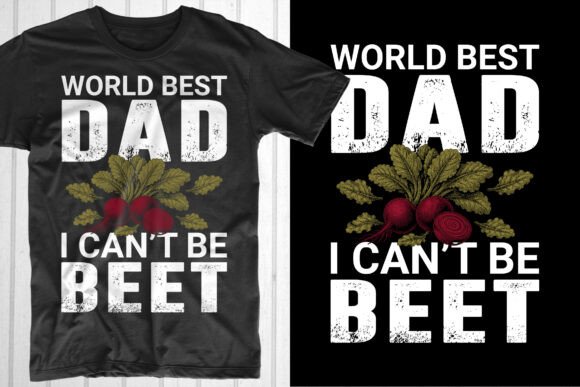
World’s Best Dad, I Can’t Be Beet
When a Pun Lands Just Right
Some designs walk a fine line between clever and cheesy, and every once in a while, one lands squarely on the right side. World’s Best Dad, I Can’t Be Beet is that kind of design. The pun is playful without trying too hard, the vegetable theme feels grounded rather than gimmicky, and the whole thing carries a warmth that makes it instantly likeable. As an embroidery designer who has tested hundreds of graphics on fabric, I pay close attention to whether a design has staying power beyond the first chuckle. This one does, partly because it speaks to a specific type of dad, the one who spends Saturday mornings in the garden, knows his soil pH, and would genuinely laugh at a beet pun on a t-shirt.
First Impressions and Visual Personality
What hits me first about World’s Best Dad, I Can’t Be Beet is the balance between text and imagery. The quote sits as the focal point, and depending on how the original graphic is constructed, there is likely a beet illustration or vegetable motif woven into the layout. The mood is light, a little rustic, and very approachable. It does not scream for attention, but it holds its own on a blank product. For embroidery purposes, this matters enormously. A design that relies on screaming colors or oversized elements often turns into a stitching headache. Something with natural charm and a clear focal area tends to translate better into thread and fabric. I can already picture this on a natural cotton tote bag or a heathered gray sweatshirt and the mental image works.
The Gardening Dad Tote: A Real-Project Test
Let me walk you through a real project scenario. I have a client who runs a small handmade product booth at seasonal markets. She wanted a Father’s Day item that was not another generic tie or tools graphic. I pulled up World’s Best Dad, I Can’t Be Beet and suggested a sturdy canvas tote bag, something a dad could take to the farmers market or use for hauling garden harvests. The design needed to sit centered on the front panel, roughly seven inches wide, and stitch out cleanly on a textured woven fabric. Before committing to the final product, I ran a test stitch on a scrap of similar canvas with a medium-weight cutaway stabilizer. The result was promising. The text legibility held up, the beet graphic read clearly, and the whole piece had a handcrafted yet polished look. This is exactly the kind of real-use evaluation that separates a good embroidery file from a frustrating one.
Where This Design Shines Brightest
After testing, I can confidently say World’s Best Dad, I Can’t Be Beet belongs on products where the fabric has some body and the surface is relatively flat. Here are the applications where I would expect the strongest results:
- Canvas tote bags in natural, oatmeal, or olive tones. The earthy vegetable theme pairs beautifully with unbleached cotton.
- Sweatshirt embroidery on crewnecks or hoodies. A left chest placement or a centered back design both work, depending on hoop size.
- Kitchen aprons for the dad who grills or cooks. A bib apron with this design near the top pocket adds personality without clutter.
- Tea towels and pillow covers for Father’s Day gift sets. These are popular craft fair items and this graphic suits that cottage-market aesthetic.
- Embroidered patches that can be sewn onto caps, jackets, or garden tool bags. The design has enough character to stand alone as a patch.
In each of these cases, the design adds perceived value to the finished product. A plain tote becomes a personalized gift. A simple apron turns into a boutique item. That transformation is what buyers notice, and it is what keeps a craft business moving.
Thread Choices and Fabric Considerations
One thing I always emphasize to Etsy sellers and small shop owners is that thread color selection can make or break a stitch-out. For World’s Best Dad, I Can’t Be Beet, the natural palette leans toward earthy reds, leafy greens, and neutral text tones. I would avoid neon or overly glossy threads here. Matte polyester or cotton-wrapped poly threads suit the rustic vibe far better. If the beet illustration includes detailed leaves or root lines, a slightly darker thread for those outlines helps the satin stitch areas pop without bleeding into the fill stitch sections. On light fabric, contrast is rarely a problem. On darker fabric, you need to test whether the green elements stay visible or get lost. A quick mockup on navy or charcoal fabric reveals this immediately, so do not skip that step.
Fabric texture also plays a role. Smooth, tightly woven cotton or cotton-blend fabrics yield the cleanest results. Toweling with a loose weave can cause stitches to sink, so increase your stabilizer weight accordingly. Stretchy fabrics like t-shirt jersey require a no-show mesh stabilizer and possibly a topper to prevent the running stitch details from tunneling. I would not recommend this design for ultra-thin performance wear unless you have experience dialing in tension for lightweight poly blends.
Products That Need a Bit More Care
Not every product is a natural home for this design, and honest evaluation matters just as much as enthusiasm. Here is where I would pause and test more carefully before offering it to a customer:
- Baby clothes and infant onesies. The design may need significant reduction in size, which puts pressure on small lettering and fine detail. Check your smallest hoop size and run a test before listing baby embroidery in your shop.
- Curved caps and hats. The horizontal layout of the text may not follow the cap seam well. You might need to re-position or split the design, which requires editing software and some patience.
- Thin or sheer fabrics. A lightweight linen could work, but you will see stabilizer show-through unless you use a quality tear-away and trim carefully after stitching.
- Heavily layered or quilted items. The design footprint needs a reasonably flat field. Avoid placing it over seams, zippers, or bulky pocket edges.
None of these are dealbreakers. They are simply the kinds of considerations that separate a professional embroiderer from someone who hits start and hopes for the best.
Small Details That Make or Break the Stitch-Out
Let us talk about the design details in World’s Best Dad, I Can’t Be Beet. The phrase itself contains apostrophes and short words that, in embroidery, can turn into muddled shapes if the stitch density is too high or the lettering too small. I always inspect the embroidery file for how the text is digitized. Clean satin stitch lettering with proper pull compensation keeps the words crisp. If the beet graphic uses fill stitch for the body and running stitch for accent lines, those transitions need to be smooth. Any jump stitches should be trimmed or programmed out. A well-digitized design handles this invisibly. A poorly digitized one leaves you with thread nests and frustration. Before investing time in a production run, stitch one sample and look at the back of the hoop. Excessive thread buildup is a warning sign.
Another practical note is to test the design in grayscale. By converting a printable mockup to black and white, you see whether the tonal values hold up without color propping them up. This matters for single-color embroidery versions or when a customer asks for a monochrome look on a dark garment.
Commercial Use and the Etsy Seller’s Perspective
Many of us are buying World’s Best Dad, I Can’t Be Beet as a digital embroidery file with the intention of selling finished products. This is where licensing clarity becomes essential. I cannot tell you what the exact license terms are for this specific design, because that information is not in front of me. What I can tell you is that you absolutely must verify the commercial use policy before listing embroidered sweatshirts, tote bags, aprons, or patches on your Etsy store or at a craft fair. Some design assets come with personal-use-only restrictions. Others allow small-batch commercial embroidery but cap the number of finished products. Do your due diligence, save the license documentation, and respect the designer’s terms. It protects your craft business and keeps the community healthy.
Giftability and Customer Reaction
Here is where World’s Best Dad, I Can’t Be Beet really earns its place in a product lineup. The emotional hook is immediate and warm. A customer browsing a handmade product booth sees the pun, laughs, and pictures their own dad or husband. That moment of recognition is what drives gift purchases. Father’s Day is the obvious seasonal anchor, but I can also see this working for birthdays, gardening club events, farm-to-table market merchandise, and even as a lighthearted retirement gift. The vegetable theme gives it more range than a purely holiday-specific graphic. A well-stitched version on a quality blank feels thoughtful, not mass-produced, and that perception builds customer trust and repeat business.
Final Practical Notes Before You Stitch
If you are adding World’s Best Dad, I Can’t Be Beet to your embroidery project queue, I recommend the following workflow. Test on scrap fabric first, matching the weight and weave of your final product. Check thread color contrast under natural and indoor lighting. Review stitch density and adjust machine tension if fill areas feel stiff or puckered. Confirm the hoop size accommodates the design at the dimensions you want. Pay close attention to the apostrophe and small letter details in the text. Use a stabilizer that matches the fabric behavior, cutaway for knits and stretch, tear-away for wovens with structure. For dark fabrics, consider a water-soluble topper to keep the top stitches crisp. Test the design in a single-color variant if you plan to offer monochrome options.
Also take a step back and look at the finished product the way a customer would. Does it make you smile? Does it feel like something worth gifting? I think this one does, and that is why I would confidently stitch it for my own handmade product line. The design has personality, clear market appeal, and a gentle humor that wears well across seasons and trends. Just make sure your execution matches the cleverness of the concept, and you will have a product that customers reach for again and again.